


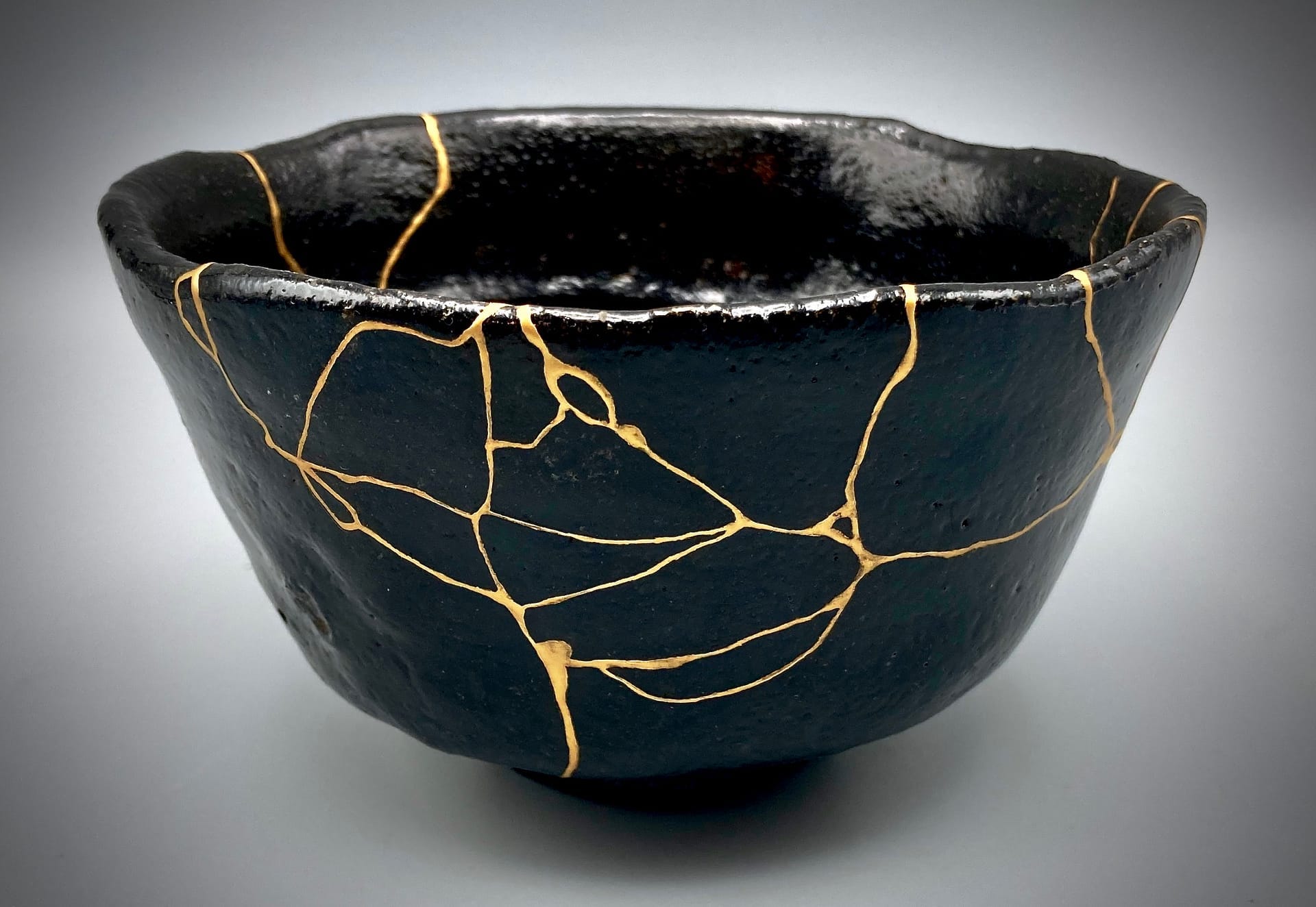
There’s something fascinating about Kintsugi—the Japanese art of mending broken ceramic vessels with gold, silver, and platinum. Kintsugi does not involve your usual kind of restoration, which seeks to obscure all traces of damage. On the contrary, it treats breakage and repair as part of the piece’s history, as something to be highlighted and celebrated.
Legend has it Kintsugi began in the fifteenth century when a Japanese shōgun sent a fractured Chinese tea bowl for repair. Once the piece was returned, the commander-in-chief found its simple metal staples visually dissatisfying; there had to be a more beautiful way to repair the damage. That’s how the ‘golden repair’ method was born. In mending gaps and fractures with gold, the Japanese believed they were rediscovering beauty in brokenness–an idea already quite prevalent in Zen Buddhism.
Kintsugi pieces tend to be fully repaired. Breakage thus does not change their function; it just equips them with more history–and a set of gold straps to account for it. As soon as they are repaired, they go back to serving as bowls, plates, or cups. Their value does not diminish either; if anything, Japanese culture treasures them more than before.
But then there are the strange ones, too, which miss crucial pieces and aren’t fully restored. You couldn’t use them at optimal capacity even if you tried. But that’s where the beauty is. The missing parts are no longer treated as flaws to be disguised; they are starting points of meditations on ideas of loss, synthesis, improvement–of crisis and cure.
I own one of these. A Kintsugi bowl that is still, fundamentally broken. Gold traces its fractures, but the large gaps remain. If you look at it really creatively, you might think it looks like a baseball glove. It cannot contain soup, rice, or tea. But it could hold something—a baseball, some ideas, attention. And maybe that is enough.
That’s what I love about Kintsugi: the idea that damage does not diminish value, even if it alters function. Kintsugi pottery is still beautiful, even though–and perhaps, because–it is imperfect.
As for why this appeals to me so much? You can probably guess.
Irrationally yours,
Dan Ariely